

Key takeaways
- The best T5 HO aquarium light fixture is the one that matches your tank length, holds enough lamps for your plants or corals.
The best T5 HO aquarium light fixture is the one that matches your tank length, holds enough lamps for your plants or corals, and includes good reflectors and an electronic ballast with decent cooling. For most owners that means choosing the fixture by tank length and lamp count first, then the lamp colors, and only then the extras.
This 2026 guide explains what T5 HO lighting does well, how to size a fixture, what features separate solid builds from weak ones, and which maintenance habits keep output steady. It avoids brand names so you can use it with any listing. It is aimed at keepers of planted freshwater tanks, reef and soft-coral tanks, and anyone upgrading from older fluorescent hoods.
What T5 HO Lighting Is Good At
T5 HO stands for high-output tubes with a thin diameter. They deliver strong, even light across the length of a tank, which suits wide, shallow displays and tanks with many tall plants. Because you can mix lamp colors, T5 HO fixtures let you shape the look and spectrum without buying new hardware.
Compared with LED fixtures, T5 HO lamps run warmer and need replacing on a schedule, but they are inexpensive to restock and produce a smooth, shadow-free glow. Many reef keepers still use them as a supplement under pendants, while planted-tank owners like how easily they cover a long, low tank.
How to Choose a Fixture
Match length and lamp count to your tank
Commonly sold sizes line up with tank lengths of 24, 36, 48 and 60 inches. Choose a fixture just shorter than the tank rim, and look at the number of lamps. Two lamps suit fish-only or low-light plants, four lamps suit moderate-to-high plant growth and soft corals, and six or more suit demanding reef setups with deeper water.
Look at reflectors and mounting
Individual reflectors above each lamp push light downward instead of out the sides, increasing usable output. Bright, polished reflectors beat dull ones. Decide between a hanging kit and a sit-on-rim design; suspended fixtures leave room for open-top tanks and heat dissipation.
Check the ballast, cooling and wiring
An electronic ballast is quieter and more efficient than older magnetic types. Fans or ventilated housings help control heat, which prolongs lamp and ballast life. Look for sealed end caps and a drip loop in the cord, since splashes and humidity are constant around tanks.
Choose lamp colors for the job
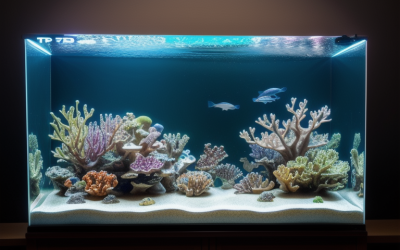
Freshwater planted tanks typically use daylight tubes in the 6500K range for strong plant growth, sometimes with a warmer tube for color. Reef setups mix blue-heavy tubes, such as actinic, with white or high-K tubes. Since lamp colors are replaceable, buy a fixture first and tune the mix later. Keep spare lamps from the same batch if you want an even look across the tank, because tubes from different makers can show slightly different tones.
Lamp Mix Guide by Tank Type
| Tank type | Typical lamp mix | Notes |
|---|---|---|
| Fish-only freshwater | Two daylight lamps | Enough for viewing; keep the photoperiod short |
| Low-tech planted | Two to three daylight lamps | Pair with hardy plants |
| High-tech planted | Four daylight lamps with reflectors | Needs CO2 and nutrient control |
| Soft-coral reef | Mix of blue and white lamps | Raise or lower with a hanging kit |
| Mixed or SPS reef | Six or more lamps, often with pendants | Heat and cooling are major concerns |
Reading the Specs Without Getting Lost
Fixture listings mix terms that sound alike. Wattage describes the electrical draw of each lamp, not the light that reaches the plants. Kelvin describes color tone, not strength. Lumens or PAR describe output, but sellers rarely publish them for T5 fixtures, so judge by lamp count, reflector quality and tank depth instead.
Depth matters as much as length. Light weakens as it travels through water, so a deep tank needs more lamps or a lower mounting height than a shallow one with the same footprint. If your tank is taller than about two feet, lean toward more lamps and good reflectors, and plan to keep demanding plants or corals in the upper half of the water column.
Heat, Humidity and Safety Basics
T5 fixtures produce noticeable heat, and an enclosed canopy can trap it. Warm air plus aquarium humidity is hard on ballasts, so ventilation is a feature worth paying for. Leave at least a few inches of air gap above the water, and make sure the fixture does not rest on a wet surface. Water and electricity do not mix, so keep plugs on a drip loop and use a ground-fault outlet if your home has one available.
If you notice a burning smell, flickering that does not stop after a lamp change, or a cracked end cap, unplug the fixture and consult the maker or a qualified electrician. Do not try to repair a ballast yourself.
Photoperiod and Algae Control
A strong fixture can grow algae as easily as plants if the schedule is wrong. Start with a short photoperiod, use a timer, and extend it only if plants show steady growth. Some keepers run two lamps for a midday burst and keep the others on shorter cycles, which mimics natural peaks and gives them room to fine-tune. Watch the glass and decor for early signs of film or spots, and reduce the schedule if they appear.
Before You Buy Checklist
- Measure the tank length and the space above it before choosing a fixture size
- Decide whether you want a hanging kit or a rim-mounted design
- Confirm the fixture includes an electronic ballast and good reflectors
- Check whether the lamps are included or sold separately
- Look for built-in fans or ventilation if the hood is enclosed
- Plan a timer plug or controller for a consistent photoperiod
- Check that replacement lamps and end caps are easy to find
Keeping Output Steady
T5 HO lamps lose output slowly, so the change is hard to spot by eye. Many keepers replace them about once a year, and mark the date on the lamp end. Planted tanks often show the effect first as slower growth or a shift in leaf color, while reef tanks may show muted coral color. A sudden algae outbreak in an established tank can be a clue that spectrum has shifted.
Wipe dust from lamps and reflectors with a damp cloth when the fixture is off and cool. Keep the fixture a safe distance above the water to reduce splash and heat, and make sure the cords hang below the outlet so water cannot run along them. If a ballast hums loudly or runs unusually hot, stop using it and consult the manufacturer.
Common Mistakes
- Buying a fixture longer than the tank and finding it will not fit
- Assuming more lamps always means better results
- Running the lights for long hours and inviting algae
- Forgetting to replace lamps on a schedule
- Skipping reflectors to save money
- Leaving cords where aquarium water can reach them
Related guides
- Canister Filter For 55 Gallon Freshwater Tank
- Programmable App Controlled Aquarium Lights
- Beneficial Bacteria Starters For Aquariums
Frequently Asked Questions
What does HO mean on a T5 lamp?
HO stands for high output. These lamps push more light through a thin tube than standard T5 versions, which is why they suit tall tanks and plant growth.
How many hours should T5 HO lights run?
Many planted-tank owners start around six to eight hours and adjust based on algae and growth. Reef keepers often use a slow ramp-up and ramp-down with a timer.
Can I mix lamp colors in one fixture?
Yes. Mixing a white or daylight lamp with a blue one is common, and you can swap lamps over time to fine-tune the look. Change one lamp at a time so you can see the effect, and give the tank a week or two to respond before swapping again.
Are T5 HO fixtures better than LEDs?
Neither is better in every case. T5 HO gives even light and easy lamp swaps, while LEDs run cooler and last longer. Choose based on tank type, budget and how much maintenance you want. If you already own a good hood and just want a spectrum upgrade, T5 HO can be a simple, low-cost route.
More from Amazon
Programs that pair well with the guide above. Offers and eligibility are set by Amazon and may change.
Set up recurring deliveries of everyday items on eligible products. Terms and savings are set by Amazon.
Explore Subscribe & SaveFree shipping on eligible items, Prime Video and more. Eligible new members can start with a free trial.
Start a Prime free trialAudiobooks and podcasts to listen to on the go. Eligible new members can start with a free trial.
Try Audible freeRead from a large library of eBooks and audiobooks on any device. Check Amazon for current plans.
Explore Kindle UnlimitedAs an Amazon Associate we earn from qualifying purchases.

Write Your Review
No reviews yet. Be the first to share your experience!