

Key takeaways
- Choose at least 500GB for a modern operating-system drive. A 1TB model is usually the better value and leaves room for updates, applications, and temporary files.
- Leave 10–20% free space. Spare space helps garbage collection and keeps performance more consistent as the drive fills.
- Prefer TLC plus DRAM for an active boot drive or frequent writes. DRAM-less designs can still be fine for light use, but their small dynamic caches and background management may be less consistent.
- Use TBW as a comparison, not a countdown. A 1TB SSD rated for 360 TBW can theoretically absorb 360,000GB of writes before its endurance rating is reached. Writing 50GB per day would equal about 18,250GB per year, so the rating represents many years of that workload, although it is not a promise of failure timing.
- Check physical compatibility. Most 2.5-inch SATA SSDs are 7mm thick and use a SATA data connector plus a separate SATA power connector. Some laptop bays need a mounting bracket or spacer.
The best SATA SSD for most people is the Samsung 870 EVO, while the Crucial MX500 is the stronger value pick and the Kingston KC600 is a good alternative when hardware encryption and broad capacity options matter.
SATA SSDs cannot match NVMe drives for peak throughput, but they remain an excellent upgrade for older desktops, laptops, game consoles, external enclosures, and systems without an M.2 slot. A good 2.5-inch SATA SSD typically delivers about 500–560 MB/s for sequential transfers and roughly 70,000–100,000 random IOPS—many times faster than a hard disk. The right choice depends less on a small difference in advertised speed and more on sustained write behavior, NAND type, endurance, warranty, and price per terabyte.
Our top picks

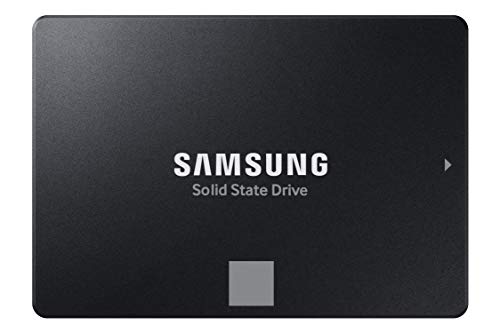
As an Amazon Associate we earn from qualifying purchases at no extra cost to you. Ratings are shown as listed on Amazon.
Best SATA SSDs at a glance
| SSD | Capacities | Rated sequential speed | Random performance | Endurance | Warranty | Best for |
|---|---|---|---|---|---|---|
| Samsung 870 EVO | 250GB–4TB | Up to 560/530 MB/s | Up to 98K/88K IOPS | 150–2,400 TBW | 5 years | Best overall |
| Crucial MX500 | 500GB–4TB | Up to 560/510 MB/s | Up to 95K/90K IOPS | 180–1,000 TBW | 5 years | Best value and general upgrading |
| Kingston KC600 | 256GB–2TB | Up to 550/500 MB/s | Up to 90K/80K IOPS | 200–1,200 TBW | 5 years | Encryption and mixed workloads |
| SanDisk SSD PLUS | 240GB–2TB | Up to about 535/450 MB/s | Lower than premium SATA models | Up to 1,200 TBW, model dependent | 3 years | Lowest-cost basic upgrade |
| TeamGroup CX2 | 256GB–2TB | Up to 540/490 MB/s | Up to about 80K/75K IOPS | Up to 1,600 TBW, model dependent | 3 years | Light everyday use at sale pricing |
Specifications vary by capacity and revision, particularly for budget SSDs. Treat the figures above as product-family guidance rather than a guarantee for every individual capacity. Sequential figures are usually quoted for fresh, lightly loaded drives; real performance can change as the drive fills or its cache is exhausted.
Samsung 870 EVO: the safest all-round recommendation
The 870 EVO uses 3D TLC NAND and a dedicated DRAM cache. Its SATA 6Gb/s interface limits it to around 560 MB/s reads and 530 MB/s writes, but that is close to the practical ceiling for this connection. Random-access performance is also strong for SATA, with Samsung rating the larger models at up to 98,000 read and 88,000 write IOPS.
Its endurance rating ranges from 150 TBW for the 250GB version to 2,400 TBW for the 4TB model, and the five-year warranty is among the best in this category. The 1TB and 2TB versions are the most attractive choices for a main operating-system drive because they combine useful spare capacity with better write endurance than the smallest model.
Choose it when reliability, predictable firmware behavior, and long-term ownership matter more than obtaining the absolute lowest price. It is not worth paying a large premium for the 870 EVO if the competing drive has the same TLC NAND, a DRAM cache, and a comparable warranty.
Crucial MX500: the value and laptop-upgrade choice
The MX500 remains a capable general-purpose SATA SSD because it pairs TLC NAND with DRAM and hardware-based AES encryption. Its quoted maximum is 560 MB/s sequential read and 510 MB/s sequential write, with up to approximately 95,000 read and 90,000 write IOPS.
Endurance is rated at 180 TBW for 500GB, 360 TBW for 1TB, 700 TBW for 2TB, and 1,000 TBW for 4TB models. It also carries a five-year limited warranty. In ordinary desktop use, the difference between an MX500 and an 870 EVO is usually much smaller than the difference between either SSD and a mechanical hard disk.
The MX500 is particularly appealing when it is priced below Samsung’s drive or when you need a 4TB 2.5-inch model for a large photo, music, or game library. Check the current label and firmware details before purchase, since component sourcing can vary across production runs.
Kingston KC600: a strong alternative for secure storage
The KC600 is a 2.5-inch SATA SSD using 3D TLC NAND, DRAM, and support for hardware-based AES 256-bit encryption, including compatibility with technologies such as TCG Opal and eDrive. Kingston rates it at up to 550 MB/s sequential read and 500 MB/s sequential write, with up to 90,000 read and 80,000 write IOPS.
Its endurance ratings are 200 TBW for 256GB, 300 TBW for 512GB, 600 TBW for 1TB, and 1,200 TBW for 2TB. The five-year warranty makes it a credible alternative to the two best-known mainstream models. It is a sensible pick for a work laptop or desktop where drive encryption matters, provided the computer and operating system are configured to use it.
Budget models: when cheaper is acceptable
The SanDisk SSD PLUS and TeamGroup CX2 can make sense for an old computer, a secondary game library, or a system that would otherwise continue using a hard drive. They are often sold at attractive prices, but budget SATA drives may use a smaller or less effective cache and may switch between NAND configurations over time.
That matters during long writes. A budget drive may initially write near its advertised speed, then slow substantially after its dynamic cache fills. This is not important when installing an operating system or opening applications, but it can matter when copying hundreds of gigabytes, editing large video files, or restoring backups.
Prefer a TLC model with published endurance and a five-year warranty for a boot drive. Use a cheaper QLC or entry-level model mainly when the workload is light and the price difference is substantial. Do not buy solely on a claimed 550 MB/s sequential number; nearly every modern SATA SSD can approach that figure under ideal conditions.
Real-world speed: what the numbers mean
Sequential speed describes large, continuous transfers such as copying a movie archive. A good SATA SSD can read or write roughly 450–550 MB/s in a sustained, short transfer. At 500 MB/s, copying 100GB would take a theoretical 200 seconds, or about 3 minutes 20 seconds. In practice, filesystem overhead, the source drive, thermals, and cache behavior can make it longer.
Random performance is more relevant to starting Windows, launching applications, browsing folders, and handling many small files. A hard disk may deliver roughly 75–200 random IOPS depending on access pattern, whereas a mainstream SATA SSD can deliver tens of thousands. This is why an older computer often feels dramatically faster after the upgrade even though SATA sequential speed is far below PCIe NVMe figures.
NVMe drives are the better choice for large media projects, frequent virtual machines, software development builds, and workloads involving sustained parallel transfers. PCIe 3.0 NVMe models commonly reach around 3,000–3,500 MB/s, while PCIe 4.0 models can exceed 7,000 MB/s. For office work, web browsing, light gaming, and normal application use, that extra peak bandwidth is often less noticeable than moving from a hard disk to any decent SSD.
Decision matrix: which SATA SSD fits your situation?
| Situation | Recommended choice | Reason |
|---|---|---|
| Old laptop with a 2.5-inch drive bay | Crucial MX500 or Samsung 870 EVO, 1TB | Good responsiveness, useful capacity, and five-year coverage |
| Main desktop boot drive | Samsung 870 EVO or Kingston KC600 | DRAM cache, TLC NAND, and strong endurance |
| Large, infrequently changed media library | Lowest-priced reputable 2TB–4TB model | Capacity and cost per terabyte matter more than peak IOPS |
| Frequent large-file writing | 870 EVO, MX500, or KC600; consider NVMe | Better sustained behavior and endurance; NVMe offers much higher bandwidth |
| Very tight upgrade budget | SanDisk SSD PLUS or TeamGroup CX2 | Still a major improvement over a hard disk, if workload is light |
| Computer with an available M.2 NVMe slot | Entry-level NVMe unless SATA is much cheaper | Higher throughput and often similar pricing |
Capacity, cache, and endurance buying rules
- Choose at least 500GB for a modern operating-system drive. A 1TB model is usually the better value and leaves room for updates, applications, and temporary files.
- Leave 10–20% free space. Spare space helps garbage collection and keeps performance more consistent as the drive fills.
- Prefer TLC plus DRAM for an active boot drive or frequent writes. DRAM-less designs can still be fine for light use, but their small dynamic caches and background management may be less consistent.
- Use TBW as a comparison, not a countdown. A 1TB SSD rated for 360 TBW can theoretically absorb 360,000GB of writes before its endurance rating is reached. Writing 50GB per day would equal about 18,250GB per year, so the rating represents many years of that workload, although it is not a promise of failure timing.
- Check physical compatibility. Most 2.5-inch SATA SSDs are 7mm thick and use a SATA data connector plus a separate SATA power connector. Some laptop bays need a mounting bracket or spacer.
Ownership realities and setup mistakes to avoid
SSDs have no moving parts, so they avoid the mechanical wear and vibration sensitivity of hard disks. NAND cells do wear with writes, but normal consumer workloads rarely approach the rated TBW. The more common ownership problems are filling the drive completely, using outdated firmware, losing data because there is no backup, or buying a drive with the wrong physical interface.
Before cloning, confirm that the replacement has enough usable capacity for the source drive’s occupied data. After installation, enable the operating system’s normal TRIM support, keep firmware updated when the manufacturer provides a relevant fix, and maintain a separate backup. TRIM helps the SSD identify deleted blocks; it does not replace backup protection.
For a new installation, connect the SSD directly to a motherboard SATA port rather than a slower legacy controller where possible. If performance is close to 300 MB/s, check whether the drive is connected through SATA II, a USB enclosure, or an adapter rather than SATA III. Finally, compare total cost per terabyte: a heavily discounted 2TB SATA SSD can be sensible, but if a similarly priced 1TB NVMe drive fits your system, NVMe usually offers better long-term value.

Write Your Review
No reviews yet. Be the first to share your experience!