

The best aquarium LED lighting for plant growth is the light that delivers the right intensity across your tank, fits its dimensions, provides a useful spectrum, and lets you control the photoperiod without making algae management harder.
For most planted aquariums, choose a dimmable full-spectrum LED with adjustable ramping and a physical length close to the aquarium’s width. Low-tech tanks generally need modest light and simple controls; medium-tech tanks benefit from stronger, programmable lighting; and high-tech tanks need high output, reliable dimming, and enough PAR at the substrate to support demanding carpet and red-stem plants.
Our top picks
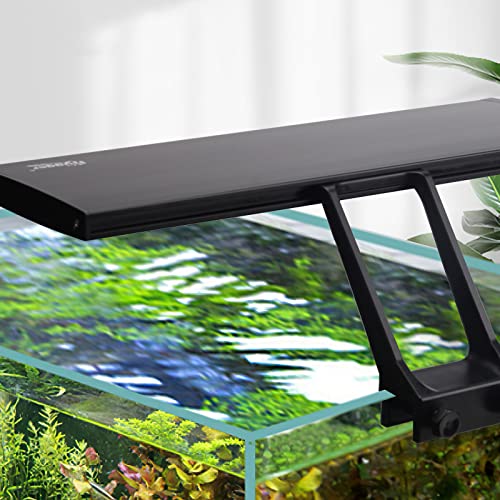
 hygger 22W 24/7 Lighting Aquarium LED Light
- DEFAULT MODE(24/7 Natural Mode): Gradient Orange light (sunrise)…
- Time + Color + Brightness can be set
- The separable adapter, if it is damaged, no…
As an Amazon Associate we earn from qualifying purchases at no extra cost to you.
Quick recommendations by planted-tank type
- Low-tech, beginner tanks: A dimmable full-spectrum bar such as the Fluval Plant 3.0 or Finnex Planted+ is a forgiving choice. Run it at moderate intensity for about 6–8 hours.
- Medium-tech tanks: A stronger programmable fixture such as the Chihiros WRGB II Slim or Twinstar S Series gives better plant coverage and color control. Begin below maximum brightness.
- High-tech tanks with injected CO2: Choose a high-output fixture such as the Chihiros WRGB II or another LED designed for high PAR. Use a controller, ramping, and careful nutrient and CO2 management.
- Shallow or narrow aquariums: Avoid automatically buying the most powerful light. Excess intensity in a shallow tank often creates algae before it improves plant growth.
- Deep aquariums or carpeting plants: Prioritize measured PAR at the substrate rather than advertised wattage or visual brightness.
What to match before buying
1. Aquarium length and mounting range
The fixture should illuminate the usable length of the aquarium without leaving dark ends. A light that is slightly shorter can work when plants are arranged toward the center, but an overhanging fixture is usually less tidy and may produce uneven coverage.
Check both the light’s physical length and its mounting system. Extendable brackets are convenient for standard rimmed aquariums, while suspension kits are better for rimless tanks, unusually wide aquariums, and fixtures that need to sit higher above the water. A light mounted higher spreads illumination more evenly but loses intensity at the substrate.
2. Intensity, not just wattage
Watts describe electricity use, not the amount of usable light reaching plants. Two LEDs with the same wattage can produce different results because of their optics, diodes, lens design, mounting height, and spectrum. PAR measured at the plant level is more useful.
As a practical starting point, many low-light plants perform well around 15–30 PAR at the substrate, medium-light plants around 30–60 PAR, and demanding carpeting or red plants may benefit from roughly 60–100 or more PAR when CO2 and nutrients are consistent. These are working ranges rather than universal rules. Plant species, water clarity, planting density, and CO2 circulation all matter.
3. Spectrum and appearance
Plants need usable light across photosynthetically active wavelengths, but aquarists also need a spectrum that makes fish and foliage look attractive. White full-spectrum LEDs are adequate for many planted tanks. RGB-enhanced fixtures can produce stronger reds and more saturated greens without relying on a heavily blue or purple appearance.
Do not select a fixture solely because it has a high color-temperature number or because the light looks bright to your eyes. A visually intense blue-white light can still be poorly distributed at the substrate. Adjustable red, green, blue, and white channels are useful for appearance, but they do not replace adequate total output.
4. Controls and photoperiod
Programmable controls are most valuable for gradual sunrise and sunset, repeatable schedules, and intensity limits. They are less valuable when they encourage constant adjustment. A stable schedule is usually easier to manage than daily changes to color and brightness.
For a new planted aquarium, start with 6–7 hours of effective light per day. If plants are growing steadily and algae remains controlled, increase toward 8 hours. A ramp period can make the total powered time longer, but the period near maximum intensity is what most strongly affects plant demand.
Best aquarium LED lighting options compared
| Light or type | Typical sizes and power | Best use | Control style | Main limitation |
|---|---|---|---|---|
| Fluval Plant 3.0 | Approx. 15–24 in / 11 W, 24–34 in / 22 W, 36–48 in / 46 W | Low- to medium-tech community and planted tanks | App-based spectrum, intensity, and schedule control | May be insufficient for demanding plants in deep tanks without careful positioning |
| Finnex Planted+ | Common aquarium lengths from about 20 to 48 in; model wattage varies | Budget low-tech setups and uncomplicated plant growth | Model-dependent remote or preset control | Less flexibility and output than premium programmable fixtures |
| Chihiros WRGB II Slim | Approx. 23 W for 30 cm, 35 W for 45 cm, 50 W for 60 cm, 75 W for 90 cm | Medium-tech tanks and visually vivid planted displays | Bluetooth/app control with dimming and channel adjustment | High output can create algae problems if intensity and CO2 are mismatched |
| Chihiros WRGB II | Common versions from roughly 30 to 120 cm; wattage rises substantially with length | High-tech aquariums, dense planting, and demanding carpets | Programmable wireless control, depending on version and controller | More expensive and less forgiving for beginners |
| High-output suspended LED fixture | Usually 60–120 cm; often about 50–150 W | Deep, wide, or aquascaped tanks requiring strong substrate PAR | External controller, timer, or app depending on model | Requires careful mounting and may spill light into the room |
Product wattages and available lengths can vary by regional version, so confirm the exact model before purchase. The table is most useful for narrowing the category, not for predicting exact PAR in a particular aquarium.
A decision matrix for common buying situations
| Your situation | Recommended direction | Why |
|---|---|---|
| First planted tank, no CO2, limited budget | Moderate-output full-spectrum bar with timer | Lower intensity reduces the chance of an algae-heavy learning curve |
| 45–60 cm tank with easy stems and epiphytes | Fluval Plant 3.0, Finnex Planted+, or equivalent dimmable LED | Enough flexibility for low- to medium-light plants without unnecessary output |
| Rimless aquascape with red plants and carpeting species | Chihiros WRGB II Slim or WRGB II, initially dimmed | Strong output, color adjustment, and useful scheduling |
| Tank deeper than 45 cm | High-output fixture with published PAR data or a PAR meter reading | Surface brightness does not guarantee sufficient substrate light |
| Unevenly lit long aquarium | Longer fixture, two shorter fixtures, or a suspended wide-spread design | Improves edge coverage and reduces bright and dark zones |
Worked sizing example
Suppose your aquarium is 60 cm wide, 30 cm front-to-back, and 36 cm tall. A 60 cm fixture is the natural starting size, but the correct intensity depends on the plants. For anubias, cryptocoryne, java fern, and moss, a moderate-output light at 40–60% may be sufficient. For a carpet of dwarf hairgrass or demanding red stems, select a higher-output model and begin around 50–70%, then adjust after observing growth and algae.
If the light is raised 15 cm above the aquarium instead of resting close to the rim, coverage may improve while substrate intensity falls. That can be useful for a wide aquascape, but it means the same fixture may need a higher setting. A PAR meter, borrowed from a local aquarium club or measured with a suitable underwater sensor, is more dependable than estimating from watts.
How to set up a new light without inviting algae
- Install it at the manufacturer’s intended height. Keep the fixture level and prevent it from touching splashing water.
- Set a conservative schedule. Use 6–7 hours of effective light initially, with a gradual ramp if available.
- Start below maximum intensity. Low-tech tanks often need only a fraction of a powerful fixture’s output.
- Keep CO2, nutrients, and circulation consistent. More light increases plant demand; increasing brightness alone does not solve slow growth.
- Wait before making changes. Observe new growth, algae, and plant posture for about two weeks before changing intensity by more than small increments.
- Adjust one variable at a time. If algae appears, reduce intensity or duration first rather than changing spectrum, fertilizer, and CO2 simultaneously.
Durability and ownership details that matter
The LED diodes themselves can last for years, but heat, humidity, salt deposits, and repeated water exposure shorten fixture life. Wipe the light’s cover and brackets with a soft, damp cloth during routine maintenance, then dry them. Do not spray cleaner directly onto the fixture. Remove mineral deposits before they become a permanent cloudy layer over the LEDs.
App-controlled lights may continue their last schedule if the phone disconnects, but behavior after a power failure varies. A simple plug-in timer can be more dependable for a basic light. Check whether replacement power supplies, brackets, and diffusers are available before buying an expensive fixture.
Common mistakes include buying by wattage alone, selecting a fixture shorter than the planted area, running a high-output light for 10–12 hours from day one, and placing the light so close that the center is intensely bright while the corners remain dim. The best aquarium LED lighting is not necessarily the strongest model; it is the one that gives your plants adequate, even, controllable light with enough adjustment left for future changes.
Final buying advice
Choose a modest, dimmable full-spectrum fixture for a low-tech aquarium; step up to a programmable RGB-enhanced light for a medium-tech aquascape; and reserve high-output models for deep tanks, demanding plants, and reliable CO2 systems. Match the fixture to the aquarium’s length, verify the mounting method, look for PAR information at the substrate, and treat scheduling as part of the purchase rather than an afterthought.

Write Your Review
No reviews yet. Be the first to share your experience!