

Key takeaways
- Deck: 7.75–8.25 inches wide and roughly 31–32 inches long.
- Trucks: Low trucks can reduce the lever distance for ollies; mid trucks are more forgiving and versatile.
- Wheels: 50–54 mm and 99A–101A for smooth concrete and skatepark surfaces.
- Bearings: Choose well-sealed bearings from an established skate component brand rather than relying on a marketing speed rating.
- Hardware: Use 7/8-inch bolts without risers, or 1-inch bolts if adding thin riser pads.
The best skateboards depend on where you will ride: choose a stable 8.0–8.5-inch popsicle deck for learning and street tricks, a wider 8.5–9-inch setup for ramps and parks, or a longer deck with larger soft wheels for comfortable cruising.
Our top picks
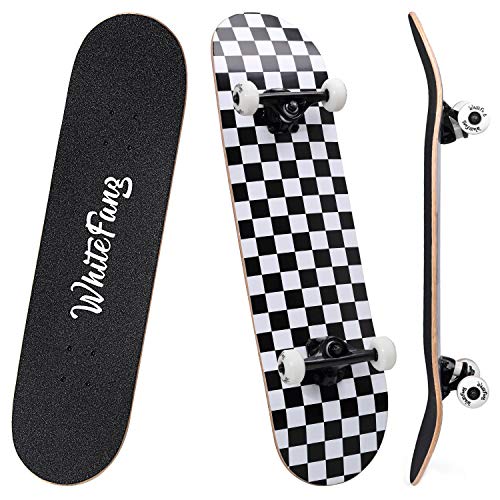


As an Amazon Associate we earn from qualifying purchases at no extra cost to you. Ratings are shown as listed on Amazon.
Quick picks by riding situation
| Riding goal | Deck recommendation | Trucks | Wheels | Why it works |
|---|---|---|---|---|
| First skateboard | 8.0–8.25 in popsicle, 31–32 in long | Medium-height, deck-matched width | 52–54 mm, 95A–99A | Balanced stability, turning, and learning space |
| Street tricks | 7.75–8.25 in popsicle, moderate concave | Low or mid trucks | 50–54 mm, 99A–101A | Lower weight and quick flip response |
| Skatepark and ramps | 8.25–9.0 in popsicle or shaped deck | Mid or high trucks | 54–58 mm, 97A–101A | More landing stability without feeling sluggish |
| Sidewalk cruising | 8.25–9.5 in cruiser, 30–36 in long | Standard or reverse-kingpin on longer boards | 60–65 mm, 78A–87A | Soft, large wheels roll over cracks and rough pavement |
| Long-distance cruising | 9.0–10.5 in, 36–42 in long | Reverse-kingpin, often loose-turning | 65–75 mm, 78A–85A | Efficient rolling and a comfortable, stable platform |
What makes a skateboard suitable for beginners?
A beginner-friendly board should feel predictable rather than maximally specialized. An 8.0–8.5-inch deck gives most new riders enough room for a comfortable stance while remaining manageable for turning and basic ollies. If your shoe size is below about US men’s 8, a 7.75–8.0-inch deck may feel easier to control; larger feet often benefit from 8.25 inches or more. These are starting points, not strict rules.
Look for a traditional popsicle shape with a symmetrical nose and tail, medium concave, and a seven-ply maple construction. Canadian maple is common because multiple thin plies provide a useful combination of pop, flex control, and impact resistance. Composite or maple-and-fiberglass decks can be durable, but the ride may feel different and replacement decks may be less readily available.
For learning, 52–54 mm wheels in the 95A–99A range are a versatile compromise. They are hard enough for basic tricks but less harsh than very hard 101A wheels on ordinary pavement. Trucks should closely match the deck width: the axle ends should sit approximately flush with the deck edges, not several millimetres inside or outside.
Best setup for street tricks
Street skating rewards a lighter, responsive setup. Choose a 7.75–8.25-inch popsicle deck with medium or steep concave if you want stronger foot lock during flip tricks. A narrower deck can rotate quickly, while a wider deck gives more landing stability. The right choice is usually the width you can stand on comfortably without your feet hanging far over the edges.
- Deck: 7.75–8.25 inches wide and roughly 31–32 inches long.
- Trucks: Low trucks can reduce the lever distance for ollies; mid trucks are more forgiving and versatile.
- Wheels: 50–54 mm and 99A–101A for smooth concrete and skatepark surfaces.
- Bearings: Choose well-sealed bearings from an established skate component brand rather than relying on a marketing speed rating.
- Hardware: Use 7/8-inch bolts without risers, or 1-inch bolts if adding thin riser pads.
Very hard wheels are not automatically faster. On rough sidewalks, they can lose momentum and vibrate heavily because they do not deform around small stones and cracks. For mixed street surfaces, 54–56 mm wheels around 93A–97A may be a better compromise, although they add a little weight and may require risers to prevent wheel bite.
Best setup for skateparks and ramps
Park riding favors a stable landing platform and wheels that maintain speed through transitions. A deck between 8.25 and 9.0 inches is a useful range for many riders. Wider decks can make coping and ramp landings feel more secure, while narrower decks are easier to flip. A moderate-to-steep nose and tail help with ollies and aerial movements.
Use mid or high trucks with wheels around 54–58 mm. High trucks provide additional clearance for larger wheels, but they raise the deck and may require more effort during ollies. Wheels in the 97A–101A range suit smooth concrete. If your local park is unusually rough, a slightly softer wheel can improve grip and comfort, but extremely soft cruising wheels can feel slow and less precise on transitions.
Keep trucks snug enough that the board does not wobble unpredictably, but do not tighten them so far that the bushings are crushed. Adjust in small increments and check that the kingpin nut still leaves visible thread beyond the nut. Replace damaged or severely cracked bushings rather than compensating with excessive tightening.
Best setup for cruising and commuting
For cruising, wheel size and softness matter more than a lightweight trick setup. Choose a cruiser deck around 8.25–9.5 inches wide, or a 36–42-inch longboard if stability and distance matter more than portability. A kicktail is useful for lifting the front over small obstacles, while a longer wheelbase tracks more calmly at speed.
Soft wheels between 60 and 65 mm and 78A–87A are a practical starting point. Larger wheels carry momentum over imperfect asphalt, but they accelerate more slowly and may need riser pads. Riser pads increase wheel clearance and can reduce wheel bite, the sudden contact between a wheel and deck during a sharp turn.
For a mixed commute, consider 60 mm wheels around 80A–85A rather than the largest available wheels. They offer a useful balance between roll speed, acceleration, clearance, and portability. A drop-through longboard is easier to push for some riders because the standing platform is lower, while a top-mount cruiser generally turns more sharply.
Deck shape, construction, and truck fit
Deck width and wheelbase
Width controls standing room and leverage; wheelbase affects turning. A shorter wheelbase turns quickly but may feel twitchy. A longer wheelbase feels steadier and is usually more comfortable for cruising. Compare wheelbase measurements, not just total deck length, because the nose and tail can add length without increasing the distance between trucks.
Concave and shape
Low or mellow concave is comfortable for cruising and beginners. Medium concave is the most adaptable option. Steeper concave can help keep your feet positioned during technical tricks, but it may feel restrictive during relaxed riding. A shaped or cruiser deck may include a raised nose, kicktail, or directional outline; these features improve utility but are less suitable for symmetrical switch tricks.
Truck width and height
Match truck axle width to the deck rather than choosing by brand name alone. A truck that is too narrow can feel unstable and place the wheels far inside the deck; one that is too wide can catch the ground during grinds and make the setup feel cumbersome. Low trucks pair well with small wheels, while high trucks provide clearance for larger wheels.
A practical decision matrix
| Your priority | Recommended choice | Avoid |
|---|---|---|
| Lowest initial cost | Complete 8.0–8.25-inch maple board with 52–54 mm wheels | Very cheap plastic hardware and unbranded trucks |
| Learning once or twice weekly | Medium concave, 95A–99A wheels, standard trucks | Highly specialized narrow trick setup |
| Riding rough sidewalks daily | Cruiser or longboard with 60–70 mm soft wheels and risers | 50 mm hard wheels |
| Limited storage or public transport | 28–32-inch cruiser or standard popsicle board | 42-inch longboard unless stability is essential |
| One board for tricks and commuting | 8.25-inch deck with 54–56 mm wheels around 93A–97A | Very soft 70 mm wheels that interfere with tricks |
Ownership costs and maintenance
A complete board typically costs about $60–$130 at the entry level, while better components assembled individually commonly bring the total to roughly $140–$300 or more. A simple cost-per-use calculation can clarify the decision: a $100 board ridden twice weekly for one year gives about 104 sessions, or approximately $0.96 per session before replacement parts. Riding frequency matters more than buying the most expensive deck.
Wheels usually wear unevenly first, especially if you brake by dragging one foot or repeatedly turn in the same direction. Rotate wheels periodically if the wear pattern allows it. Bearings may slow because of water, grit, or over-lubrication; remove shields only when you know the bearing design permits it, clean with an appropriate solvent, and use only a small amount of skate-bearing lubricant. Never soak wooden decks, and dry the board immediately if it encounters rain.
Inspect the deck for cracks around the truck bolts, check that hardware remains tight, and look for flat spots on the wheels. Do not ride a deck with a structural crack, delaminated layers, or a loose truck baseplate. Keep the board out of a hot car, where heat can soften adhesives and distort components.
Bottom line
For most first-time riders, the safest all-round choice is an 8.0–8.5-inch, seven-ply maple popsicle complete with correctly matched trucks and 52–54 mm medium-hard wheels. Choose a narrower, lighter setup when street tricks are the priority, a wider setup with 54–58 mm wheels for parks, and a cruiser or longboard with 60 mm-or-larger soft wheels when comfort over rough pavement matters most.



Write Your Review
No reviews yet. Be the first to share your experience!