

Key takeaways
- Choose a well-built 1,800-watt digital burner with many power levels for the best all-purpose performance. Pick a compact 1,300- to 1,500-watt model when weight, storage, or occasional backup use matters more than speed. If your priority is delicate temperature work rather than simple boiling and…
Best Portable Induction Cooktops
The best portable induction cooktop for most people is an 1,800-watt single-burner model with precise power levels, a temperature display, automatic pan detection, and a footprint close to 12 by 15 inches; choose a lower-cost 1,300- to 1,500-watt unit for occasional backup cooking, or a temperature-controlled model for demanding simmering and specialty cooking.
Portable induction burners heat magnetic cookware directly rather than heating a coil or glass surface first. That makes them fast, efficient, and relatively easy to clean, but they are only useful with compatible pans and a reliable electrical outlet. The right choice depends less on headline wattage than on how precisely the cooktop controls low heat, how easily it fits your counter or luggage, and whether its safety features suit your household.
Our top picks
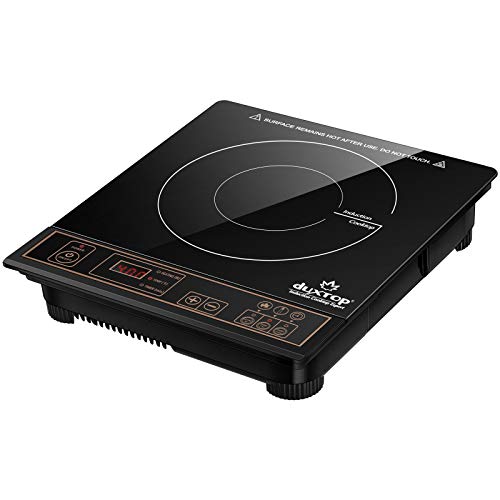
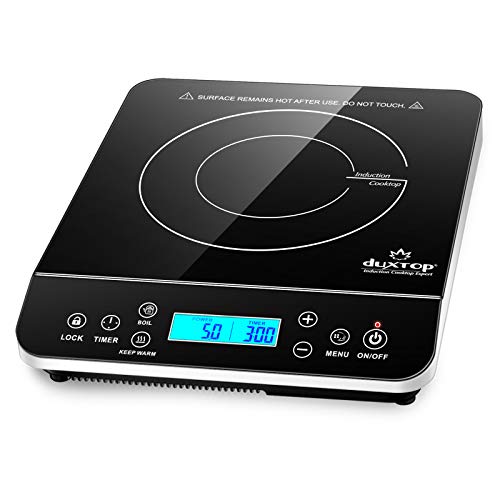


As an Amazon Associate we earn from qualifying purchases at no extra cost to you. Ratings are shown as listed on Amazon.
Quick comparison of strong portable induction cooktop choices
| Type or example | Maximum power | Control range | Approximate size and weight | Best suited to |
|---|---|---|---|---|
| Duxtop 9600LS | 1,800 W | 20 power levels; approximately 100–460°F temperature range | About 13 × 11.5 inches; about 10–12 lb | Everyday cooking, frequent backup use, and cooks who want fine adjustment |
| Nuwave PIC Gold or similar 1,800-W digital burner | 1,800 W | Multiple power and temperature settings; model-dependent | Typically about 12 × 15 inches; roughly 6–9 lb | General cooking when portability and simple digital controls matter |
| IKEA TILLREDA portable induction hob | Up to 1,800 W, depending on version and market | Several stepped power settings | About 11 × 12 inches; approximately 6–7 lb | Small kitchens, dorm-style spaces, and occasional use |
| Temperature-controlled induction cooktop, such as Breville Control Freak | Up to about 1,800 W | Very precise temperature programming, often with probe support | Roughly 16 × 15 inches; considerably heavier than basic burners | Serious recipe work, chocolate, sauces, frying, and controlled holding temperatures |
| Compact 1,300–1,500-W travel burner | 1,300–1,500 W | Usually 6–10 power levels | Commonly 10–12 × 10–14 inches; about 4–7 lb | Light travel, emergency cooking, and low-demand reheating |
Dimensions and settings can vary by regional version, so check the product label before buying. The table is most useful as a performance guide: 1,800 watts is the practical ceiling for many household outlets, while lighter models trade boil speed for easier transport.
What matters most when choosing
Wattage and electrical demands
An 1,800-watt cooktop brings water to a boil faster and recovers heat more quickly after food is added. It is the better choice for pasta, large pots of soup, cast-iron searing, and regular meal preparation. A 1,300- or 1,500-watt unit uses less peak power but can feel slow with a large pot or a crowded cooking schedule.
At 1,800 watts on a 120-volt circuit, the theoretical current is:
1,800 W ÷ 120 V = 15 A.
That leaves little capacity on a typical 15-amp household circuit. Plug the cooktop directly into a suitable wall outlet, avoid extension cords unless the manufacturer specifically permits an appropriately rated one, and do not run another high-wattage appliance on the same circuit. In an RV, cabin, or generator setup, verify that the inverter or generator can supply the cooktop’s surge and continuous load.
Temperature control versus power control
Many inexpensive induction burners advertise temperature settings, but those settings may be broad approximations. A power-level control regulates energy delivered to the pan; a temperature mode may cycle the power to target a programmed surface or pan temperature. For boiling and sautéing, power levels are usually enough. For delicate sauces, custards, frying, and chocolate, more frequent adjustments or a true temperature sensor are valuable.
For most households, 10–20 power levels are a better target than an impressive number of preset cooking programs. Look for a low setting that can maintain a gentle simmer without repeatedly boiling over. A built-in timer is useful, but it should not replace supervision.
Cookware compatibility
Induction requires a ferromagnetic base. Cast iron, enameled cast iron, and many stainless-steel pans work. Aluminum, copper, glass, and ordinary ceramic cookware do not work unless they have an induction-compatible magnetic layer.
Test a pan with a refrigerator magnet: if it sticks firmly to the bottom, the pan is likely compatible. The base must also sit flat and fall within the cooktop’s stated diameter range. A small pan may heat unevenly on a large cooking zone, while an oversized pan can leave the outer food cooler than the center.
Induction-compatible cookware often costs more, and rough cast iron can scratch a glass cooking surface. Lift heavy pans instead of dragging them, and avoid using a warped pan that rocks on the burner.
Safety features
Prioritize automatic pan detection, overheat protection, a residual-heat indicator, a child lock, and an automatic shutoff timer. Pan detection stops or reduces heating when cookware is removed, although the glass surface can remain hot from the pan. A child lock prevents accidental button presses but does not make the surface safe to touch immediately after cooking.
Keep the air vents clear, especially when using the unit in a small camper or on a shelf. Do not place it directly beside a sink where splashes can reach the controls or ventilation openings. Never leave oil heating unattended.
Best choice by situation
| Your situation | Recommended specification | Why |
|---|---|---|
| Small counter or dorm room | 1,300–1,500 W; under 12 lb; compact controls | Uses less space and is adequate for one-person meals |
| Frequent everyday cooking | 1,800 W; 15 or more power levels; timer and pan detection | Faster heating and better control over different pans |
| Backup during a range failure | 1,800 W; durable glass top; large cooking zone; direct wall connection | Can handle a normal saucepan or stockpot when one burner is unavailable |
| Travel or RV use | 4–8 lb; 1,300–1,500 W; confirmed voltage and inverter compatibility | Lower weight is easier to pack, but electrical capacity becomes critical |
| Precise sauces or frying | Fine-grained controls, low simmer performance, or probe-based temperature control | Reduces cycling and makes target temperatures easier to maintain |
Portable cooking: a realistic sizing and runtime check
Suppose you want to boil 2 liters of water. Heating water from 68°F to 212°F requires approximately:
2 kg × 4.186 kJ/kg°C × 80°C ≈ 670 kJ.
An 1,800-watt cooktop supplies 1.8 kilojoules per second. Allowing for heat lost through the pan and air, a practical result may be around 9–13 minutes, depending on the lid, pan, starting temperature, and cookware. A 1,300-watt burner will generally take longer. Covering the pan and using a flat, correctly sized induction vessel saves more time than repeatedly changing settings.
For battery or inverter travel, energy use is also significant. Running an 1,800-watt cooktop for 20 minutes consumes about 600 watt-hours before inverter losses. That is a substantial load for a portable power station, so a 1,300-watt burner or shorter, covered cooking sessions may be more practical.
Ownership realities: cleaning and durability
The glass top is easy to wipe once it has cooled, but sugary spills and starch can harden into difficult residue. Switch off the unit, allow it to cool, and use a soft cloth with a manufacturer-approved glass cooktop cleaner. Do not pour cold water over a hot surface, immerse the appliance, or use abrasive scouring pads.
The parts most likely to cause trouble are the cooling fan, touch-control panel, power cord, and glass surface rather than the induction coil itself. Keep flour, grease, and moisture away from the vents and controls. Store the cooktop flat with padding above it; stacking heavy cookware on the glass can cause chips or cracks. If the display shows an error, first remove the pan, let the unit cool, and check that the inlet and outlet vents are unobstructed.
Bottom line
Choose a well-built 1,800-watt digital burner with many power levels for the best all-purpose performance. Pick a compact 1,300- to 1,500-watt model when weight, storage, or occasional backup use matters more than speed. If your priority is delicate temperature work rather than simple boiling and sautéing, pay for genuine temperature sensing and accept the greater size and weight. In every case, confirm cookware compatibility and electrical capacity before treating a portable induction cooktop as your primary or travel cooking appliance.

Write Your Review
No reviews yet. Be the first to share your experience!