

Key takeaways
- Dust buildup: Unplug the fan, remove the front grille if the manual permits, and clean the grille and blades with a soft brush or vacuum. Dust reduces airflow and can create imbalance.
- Humidity: In aquarium rooms, keep the motor housing away from splash zones and do not operate the fan with wet hands. Condensation and salt residue can corrode fasteners and electrical contacts.
- Rattling: Check the base, stand collar, grille clips, and blade cap before blaming the motor. A slightly loose grille can sound louder than the fan itself.
- Oscillation wear: The oscillation gearbox and plastic pivot are commonly stressed first. Do not force the head through its range, and switch oscillation off when the fan is stored.
- Control reliability: Mechanical switches are simple and repair-friendly, while touch panels and app features offer convenience but add electronic components that may be affected by moisture or power interruptions.
The best pedestal fan for powerful airflow is the Vornado 683DC for long-range circulation, while the Dreo PolyFan 715S is the better choice for quiet rooms, smart controls, and broad oscillation. For a bedroom, office, or aquarium room, choose based on whether you need concentrated air movement, wide coverage, low noise, or simple mechanical controls rather than choosing by blade diameter alone.
Our top picks


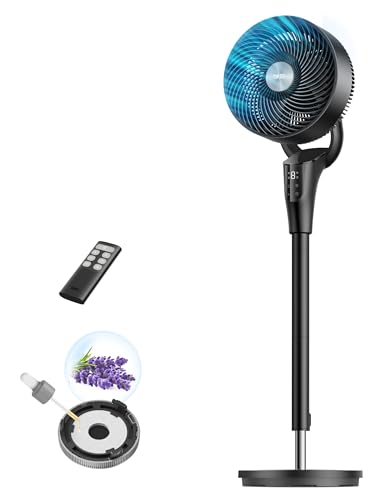

As an Amazon Associate we earn from qualifying purchases at no extra cost to you. Ratings are shown as listed on Amazon.
Best pedestal fans at a glance
| Fan | Best for | Airflow approach | Noise and controls | Oscillation and height | Typical market range |
|---|---|---|---|---|---|
| Vornado 683DC | Maximum circulation and large rooms | Focused, long-range air column | Variable-speed DC dial; quieter at low settings | Manual vertical aim; horizontal oscillation is limited compared with room-wide models; roughly 41–48 in. tall | $140–$200 |
| Dreo PolyFan 715S | Quiet bedrooms, offices, and smart-home use | Strong airflow with wide distribution | Multiple speeds, display and remote/app controls; low-speed operation can be very quiet | About 120° horizontal oscillation and approximately 37–43 in. height adjustment | $80–$130 |
| Rowenta Turbo Silence Extreme+ | Quiet personal cooling with conventional controls | Powerful direct airflow from a large blade assembly | Several speed settings, remote control, and a quiet mode | Broad horizontal oscillation; adjustable height is approximately 42–54 in. | $100–$160 |
| Basic 16-inch pedestal fan | Budget use and occasional circulation | Short-to-medium range airflow | Usually 3 speeds and push-button controls | Often 70–90° oscillation and approximately 40–50 in. height | $25–$60 |
Specifications vary by region and revision, so treat the figures above as practical comparison points rather than a substitute for the individual model’s manual. The important distinction is that a high-airflow circulator pushes air across a room, whereas a traditional oscillating pedestal fan mainly cools the area directly in front of it.
Best for powerful, long-range airflow: Vornado 683DC
The Vornado 683DC is the strongest fit when your priority is moving air from one side of a room to the other. Its circulator-style grille and deep blade design produce a concentrated stream instead of spreading the output immediately across a wide angle. That makes it useful in large living rooms, workshops, garages, and fish rooms where air needs to travel around furniture or between equipment.
The variable-speed DC control is more useful than a simple three-speed switch. You can select a low setting for continuous circulation or increase the output when mixing warm and cool air. In an aquarium room, this can help reduce stagnant, humid pockets around tanks and equipment, but the fan should move room air rather than blow directly across open water all day. Direct airflow increases evaporation and may lower water temperature unexpectedly.
The compromise is coverage. This is not the best pick if you want one fan to sweep air evenly across several people. Its vertical adjustment is useful, but its aiming range and circulation pattern are less expansive than a modern 120-degree oscillating fan.
Best quiet smart fan: Dreo PolyFan 715S
The Dreo PolyFan 715S is the most versatile choice for bedrooms, home offices, and smaller aquarium rooms. Its wide oscillation, multiple speed settings, remote control, and app-compatible controls make it easier to fine-tune than a basic pedestal fan. A low setting can provide background circulation without the constant rush of air associated with inexpensive high-speed motors.
Its broad oscillation is especially useful when the fan needs to cover a desk, sofa, and nearby tank rather than aim at one fixed point. The display and controls also make it easier to change settings without walking across the room. Smart scheduling can be useful for running the fan during the warmest part of the day, though a manual timer is enough if you do not need remote access.
Choose it over the Vornado when the room is medium-sized and you value quiet operation and distribution more than maximum throw. For a large, open room, its wide pattern may feel less forceful at the far end than the Vornado’s concentrated airflow.
Best quiet conventional option: Rowenta Turbo Silence Extreme+
The Rowenta Turbo Silence Extreme+ suits people who want a traditional pedestal fan with a quieter operating mode and a tall height range. Its larger adjustment range is helpful beside a bed, sofa, or standing workstation because the grille can be positioned closer to head height instead of blowing at the floor.
It offers a useful middle ground: more directional power than many inexpensive 16-inch fans, but a broader and more familiar oscillating pattern than a dedicated air circulator. The remote control is convenient for nighttime adjustments, and the lower settings are better suited to sleeping than an inexpensive fan that has only “low,” “medium,” and “high.”
Its main limitation is value. It costs more than basic pedestal fans without providing the same smart-home features as the Dreo or the same long-range circulation character as the Vornado. It is a sensible purchase when low noise and conventional operation matter more than app control.
How to choose by room and situation
| Your situation | Best fit | Why |
|---|---|---|
| Large room, high ceiling, or workshop | Vornado-style air circulator | Concentrated airflow travels farther and mixes the room more effectively. |
| Bedroom where noise matters most | Dreo or Rowenta quiet model | Lower-speed control and sleep-oriented operation reduce unnecessary output. |
| Several people spread across a room | Wide-oscillating pedestal fan | A 90–120° sweep distributes air better than a fixed circulator. |
| Fish room with humidity and heat pockets | Variable-speed circulator | Continuous low airflow can mix room air without creating excessive evaporation. |
| Occasional summer use and tight budget | Basic 16-inch model | Three speeds and mechanical controls are inexpensive and easy to replace. |
| Frequent daily use | DC-motor model | Fine speed adjustment and efficient low-speed operation are more useful over time. |
Airflow, noise, and oscillation: what the specifications do not tell you
Airflow
Blade diameter is only one part of performance. A 16-inch fan with a deep grille and efficient motor can outperform a larger, shallow fan at moving air across a room. Look for a variable-speed control if you want to balance comfort, noise, and evaporation. Maximum speed is useful for initial room mixing, but continuous operation usually works better at a lower setting.
Noise
Manufacturers often quote noise at the lowest speed, so published decibel numbers are not directly comparable. Motor hum, grille turbulence, and rattling can matter more than the headline rating. A fan with many speed steps lets you avoid the uncomfortable gap between “too weak” and “too loud.” Place the fan on a solid, level surface and tighten the grille and stand screws before assuming the motor is noisy.
Oscillation and height
Wide oscillation improves coverage but can reduce the force felt at any single position. Height adjustment is most useful when matching the fan to the room’s occupants: aim over a seated person’s shoulders, across a standing work area, or above aquarium equipment rather than directly at an open tank. A tilting head is often more valuable than a few extra inches of stand height.
Placement and operating-cost calculation
For room circulation, place the fan several feet from a wall with the airflow aimed diagonally across the room. Avoid forcing air directly into a tank, heater, filter intake, or pile of loose material. If you are exhausting hot air through a window, place the fan close to the opening and seal large gaps; if you are mixing room air, keep it farther inside the room.
As an example, suppose a DC fan draws 35 watts and runs 10 hours each day. At an electricity rate of $0.18 per kilowatt-hour:
0.035 kW × 10 hours × $0.18 = $0.063 per day
That is about $1.90 per month when used every day. A 70-watt fan under the same conditions costs about $3.80 per month. The difference is modest, but a lower-power fan may also produce less heat and allow quieter continuous operation. Electricity rates and actual power draw vary, so use the wattage printed on the fan or measured at the outlet for a closer estimate.
Ownership, cleaning, and common failure points
- Dust buildup: Unplug the fan, remove the front grille if the manual permits, and clean the grille and blades with a soft brush or vacuum. Dust reduces airflow and can create imbalance.
- Humidity: In aquarium rooms, keep the motor housing away from splash zones and do not operate the fan with wet hands. Condensation and salt residue can corrode fasteners and electrical contacts.
- Rattling: Check the base, stand collar, grille clips, and blade cap before blaming the motor. A slightly loose grille can sound louder than the fan itself.
- Oscillation wear: The oscillation gearbox and plastic pivot are commonly stressed first. Do not force the head through its range, and switch oscillation off when the fan is stored.
- Control reliability: Mechanical switches are simple and repair-friendly, while touch panels and app features offer convenience but add electronic components that may be affected by moisture or power interruptions.
Final recommendation
Choose the Vornado 683DC when powerful, long-range airflow is the deciding factor. Choose the Dreo PolyFan 715S for the best combination of quiet operation, broad oscillation, and flexible controls. Choose the Rowenta Turbo Silence Extreme+ when you want a tall, quiet, conventional fan with a remote. A basic 16-inch pedestal fan remains the practical budget option for occasional use, but frequent users will usually appreciate variable speed, a sturdier stand, and easier cleaning.

Write Your Review
No reviews yet. Be the first to share your experience!