

Key takeaways
- A medium-cut compound and microfiber or firm foam pad for moderate swirls, water spotting and oxidation.
- A finishing polish and soft foam pad to refine haze and restore clarity.
- A panel wipe to remove polishing oils before judging the result.
- A paint sealant or ceramic spray to protect the corrected finish.
The best paint correction kits for most DIY detailers are a dual-action polisher paired with a cutting compound, a finishing polish, two pad types, panel wipe, and a short-term sealant; choose a mild 8 mm kit for light swirls, a 15 mm kit for faster whole-car work, or a compact machine and microfiber cutting pads when defects are deeper or access is tight.
Our top picks
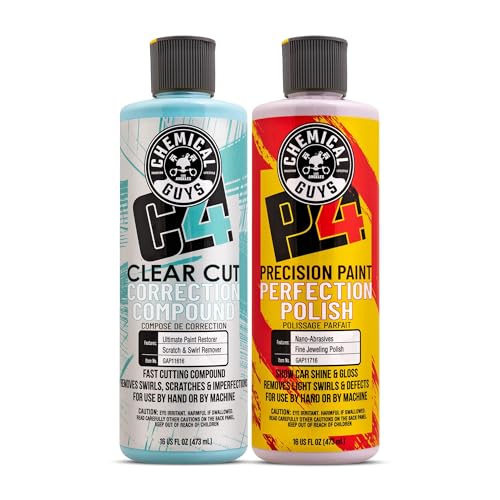
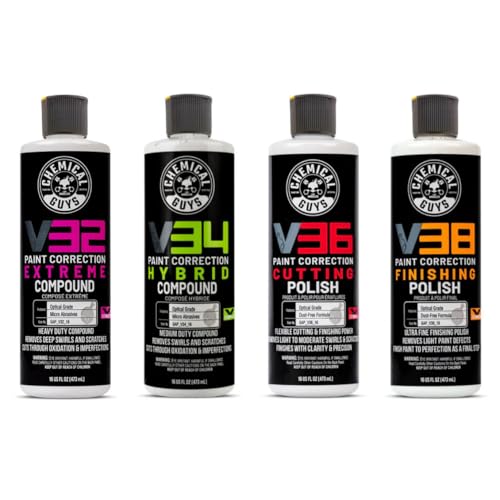
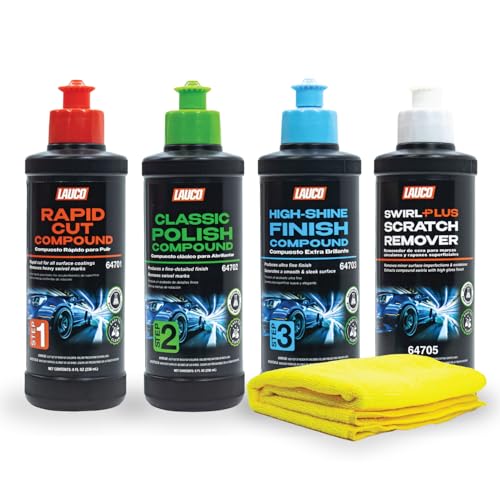

As an Amazon Associate we earn from qualifying purchases at no extra cost to you. Ratings are shown as listed on Amazon.
Best paint correction kits by situation
| Situation | Best kit format | What it should include | Typical market range |
|---|---|---|---|
| Light swirls on an otherwise glossy car | 8 mm dual-action kit | 6-inch polisher, finishing polish, foam polishing and finishing pads, sealant | $180–$300 |
| Moderate defects across a large vehicle | 15 mm dual-action kit | 5-inch backing plate, compound, polish, microfiber or firm foam cutting pads, finishing pads | $300–$550 |
| Deep-looking scratches and isolated defects | Compact 3-inch/4-inch machine plus a regular polisher | Small backing plates, microfiber cutting pads, compound, inspection light, panel wipe | $250–$600 |
| Occasional correction on a tight budget | 8 mm corded kit with generic consumables | 6-inch machine, two compounds or one versatile polish, at least four pads, protection | $130–$220 |
| Frequent detailing or large SUVs | 15 mm professional-style kit | Low-vibration machine, interchangeable backing plates, bulk pads, compound, polish and ceramic-compatible protection | $450–$800 |
Our strongest all-round recommendation: an 8 mm dual-action kit
An 8 mm random-orbit polisher, such as the Griot’s Garage G9, is the safest starting point for a DIY detailer. Its shorter orbit is easier to control around body lines, requires less technique than a rotary polisher, and works well with a 5.5- or 6-inch pad. A kit built around this machine is especially suitable for daily drivers with wash marring, light haze and fine circular swirls.
Look for a versatile diminishing or low-dust compound rather than an extremely aggressive product. A compound such as Meguiar’s Ultimate Compound can remove moderate defects when paired with a firm foam or microfiber pad, while a finishing polish such as Meguiar’s Ultimate Polish is more appropriate for light correction and gloss enhancement. These consumer products are forgiving, but they may need multiple passes on hard clear coat.
The important limitation is speed. An 8 mm machine corrects effectively, but it removes defects more slowly than a long-throw machine. That is a reasonable trade-off when you are learning, working in a small garage, or correcting one vehicle once or twice per year.
Best for full-car correction: a 15 mm long-throw kit
A 15 mm dual-action polisher gives a useful middle ground between control and productivity. The Rupes BigFoot LHR15 Mark V is a well-known example: it uses a 15 mm orbit, a 5-inch backing plate, and variable operating speed in the roughly 3,000–5,200 orbits-per-minute range. A 15 mm kit covers panels efficiently while remaining more manageable than a 21 mm machine on curved or narrow sections.
Pair this type of machine with a two-stage system:
- A medium-cut compound and microfiber or firm foam pad for moderate swirls, water spotting and oxidation.
- A finishing polish and soft foam pad to refine haze and restore clarity.
- A panel wipe to remove polishing oils before judging the result.
- A paint sealant or ceramic spray to protect the corrected finish.
Rupes DA systems are designed around matched pad-and-compound combinations, while systems from Koch-Chemie, Sonax and Meguiar’s can also be assembled around a standard 5-inch or 6-inch backing plate. Matching the abrasive and pad is more important than buying the most expensive machine: an aggressive compound on a soft finishing pad may underperform, while a strong microfiber pad can leave its own haze that requires a second step.
When a compact polisher is the better choice
Deep-looking defects are often concentrated around door handles, bumpers, pillars, mirrors and tight body contours. A compact machine such as the FLEX PXE 80 is useful in these areas because its small pads and interchangeable drive options provide more control than a full-size polisher. The machine is not a substitute for a regular polisher on an entire vehicle, but it can prevent awkward hand-polishing and improve access to localized damage.
For isolated defects, use a microfiber cutting disc with a medium or heavy compound, then switch to a small soft foam pad and finishing polish. Do not assume a scratch is safely removable because a kit includes an aggressive compound. If a fingernail catches strongly, the mark reaches through the clear coat, or the panel has been repainted unevenly, polishing may only improve its appearance. Wet sanding or refinishing may be required, and those jobs are best left to a qualified professional.
Compounds, pads and protection: what actually matters
Compounds
Heavy-cut compounds remove defects fastest but also create more haze, dust or micro-marring. Medium compounds are the most useful choice for a first correction because they can improve a broad range of defects without committing immediately to a two- or three-step process. Finishing polishes contain finer abrasives and are intended to refine the surface rather than remove deep scratches.
Pads
Foam pads are predictable and easy to wash. Firm foam provides more cut, medium foam is versatile, and soft foam is used for finishing. Microfiber pads generally cut faster, especially on hard clear coat, but they load with spent polish and must be brushed or blown clean frequently. A useful starting quantity is four cutting pads and four finishing pads for a medium-sized vehicle; rotating clean pads helps maintain correction and reduces heat.
Polisher design
A forced-rotation or rotary machine can correct quickly, but it demands more care around edges and can generate excessive heat. A free-spinning dual-action machine is the better default for DIY work. Corded machines are usually lighter and provide unlimited runtime. Battery machines are convenient, but budget for spare batteries and a charger if you plan to correct more than one panel at a time.
Protection
Some kits stop after polishing, which leaves the finish vulnerable to contamination. A synthetic sealant normally provides several months of protection when the paint is clean and properly prepared. Ceramic sprays can last longer than a basic wax when maintained correctly, but they still require careful application and do not make paint scratch-proof. A kit containing only compound and pads is incomplete unless you already own panel wipe and protection.
Head-to-head: 8 mm versus 15 mm versus compact machines
| Feature | 8 mm DA | 15 mm DA | Compact 3–4 inch machine |
|---|---|---|---|
| Typical backing plate | 5–6 inches | 5 inches | 2–3 inches |
| Best correction area | Whole vehicle | Whole vehicle, faster | Small panels and tight contours |
| Learning curve | Lowest | Low to moderate | Moderate because pad control is less forgiving |
| Typical working speed | Moderate | Fast | Slow across large panels |
| Pad consumption for one medium car | 6–10 pads | 8–12 pads | 4–8 small pads for spot work |
A practical buying calculation
Suppose a medium car needs four cutting pads and four finishing pads. If foam pads cost about $8–$15 each, the pad portion is approximately $64–$120. Add $35–$60 for compound and polish, $15–$30 for panel wipe, and $20–$45 for sealant. A $170 machine can therefore become a $304–$425 first-use setup before towels and masking tape.
For an owner correcting one car every two years, a budget 8 mm kit is sensible. For four cars per year, a better machine and washable, durable pads can cost less over time because faster correction and replaceable consumables reduce labor and frustration.
How to use and maintain the kit
- Wash, chemically decontaminate and clay the paint only where needed. Polishing over bonded grit can create fresh marring.
- Test a small area with the least aggressive pad and polish combination. Increase cut only if the result is insufficient.
- Work a section roughly 18 by 18 inches at a moderate speed, using slow overlapping passes and light-to-moderate pressure.
- Wipe the residue, inspect under strong neutral light, and use panel wipe before deciding whether the defect is actually gone.
- Clean or change the pad after each panel. A saturated pad cuts poorly, runs hotter and can smear abrasive residue.
- Apply protection only after the paint is residue-free. Wash pads promptly with suitable pad cleaner, rinse thoroughly and air-dry them face-up.
The parts that wear first are usually foam edges, microfiber fibers, backing-plate hook-and-loop material and power cords near the machine body. Never operate with a torn pad or a backing plate larger than the pad. Store compounds closed and away from freezing temperatures, and replace products that have separated permanently or developed hard particles.
Final buying advice
Choose an 8 mm dual-action kit with medium and finishing pads for light swirls and first-time correction. Choose a 15 mm kit when you regularly correct complete vehicles and want to reduce working time. Add a compact machine when your problem is access rather than total paint-area correction. Whichever format you select, prioritize a matched compound-and-pad system, enough spare pads, panel wipe and real paint protection over a kit that simply advertises the highest cutting power.

Write Your Review
No reviews yet. Be the first to share your experience!