

Key takeaways
- Seat depth, so the cushion supports the thighs without pressing behind the knees.
- Armrest width and whether the armrests flip up or adjust outward.
- Seat-to-floor height, particularly if standing transfers are difficult.
- Handlebar or tiller reach while the back remains against the seat.
- Maximum seat height under a table, desk, or vehicle transfer point.
The best heavy duty mobility scooters for stability are the Pride Jazzy 1450 for maximum capacity, the Pride Maxima for a balanced indoor/outdoor option, and the Golden Buzzaround XL HD for a more compact scooter that still accommodates larger riders.
Our top picks


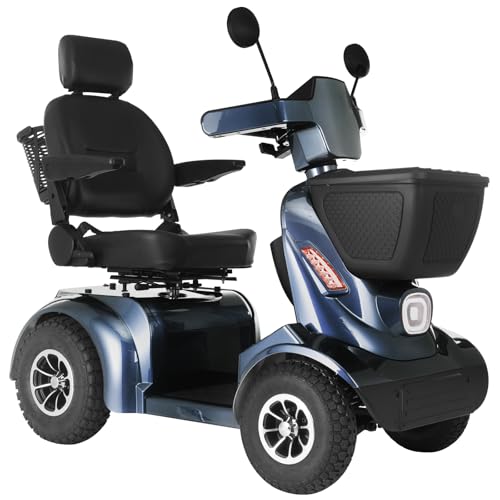
As an Amazon Associate we earn from qualifying purchases at no extra cost to you. Ratings are shown as listed on Amazon.
Quick comparison
| Model | Weight capacity | Seat width | Turning radius | Typical range | Best suited to |
|---|---|---|---|---|---|
| Pride Jazzy 1450 | 600 lb | About 22–24 in, depending on configuration | About 70 in | Up to roughly 15.5 miles | Maximum capacity and outdoor stability |
| Pride Maxima 4-wheel | 500 lb | About 22 in | About 65 in | Up to roughly 19 miles | Large riders who need a versatile full-size scooter |
| Golden Buzzaround XL HD | 450 lb | About 20 in | About 54 in | Up to roughly 18 miles | Smaller homes, paved paths, and easier storage |
Specifications can change with battery size, seat configuration, and model year. Treat the figures above as a shortlisting guide, then confirm the exact configuration with the manufacturer or mobility dealer before ordering.
Our picks by situation
Best for the highest weight capacity: Pride Jazzy 1450
The Pride Jazzy 1450 is the strongest choice when the rider’s priority is a generous safety margin above body weight. Its 600-pound capacity, large four-wheel footprint, high ground clearance, and full suspension make it better suited to outdoor surfaces than a compact travel scooter.
The trade-off is substantial size. A turning radius around 70 inches can make kitchens, narrow hallways, and crowded shops frustrating. The scooter itself is also too heavy for most people to lift into a vehicle. Plan on a rear-mounted vehicle lift, an accessible van, or a ramp system rated for the scooter and rider’s combined requirements.
Best all-rounder: Pride Maxima 4-wheel
The Pride Maxima offers a useful middle ground: a 500-pound capacity, a broad seat, full-size tires, suspension, and a range that is generally sufficient for local errands. It is more manageable than the Jazzy 1450 while remaining substantially more stable than a lightweight folding scooter.
Choose it for regular neighborhood travel, shopping centers, and paved paths where stability matters more than portability. Its turning circle still requires planning in small rooms, so measure doorways and the tightest turning point—not just the front door.
Best for tighter storage: Golden Buzzaround XL HD
The Golden Buzzaround XL HD is a better fit when a rider needs a heavy-duty scooter but has limited indoor storage or a smaller vehicle. Its 450-pound capacity and approximately 20-inch seat provide more room than standard travel scooters, while its shorter chassis and smaller turning radius are easier to live with.
This is still not a lightweight lift-in scooter. “More compact” does not mean easy to carry. Some configurations use removable battery components, but the base and seat can remain heavy. Confirm the heaviest individual piece before buying.
How to choose the right heavy-duty scooter
1. Calculate capacity with a margin
Do not match the scooter’s rated capacity exactly to the rider’s current weight. Include clothing, shoes, bags, oxygen equipment, shopping, and any accessories. A practical calculation is:
Required capacity = rider weight + regular cargo + safety margin.
For example, a 390-pound rider carrying 25 pounds of personal items has a 415-pound operating load. A 450-pound scooter leaves only 35 pounds of rated capacity. A 500-pound model leaves 85 pounds, providing a more sensible margin for occasional groceries or a heavier coat.
The capacity rating is not a recommendation about body weight or fitness. If posture, transfers, balance, or seating pressure are concerns, ask a qualified occupational or physical therapist to assess the seating and controls.
2. Fit the seat, not just the weight rating
Seat width should allow the rider to sit upright without the armrests pressing into the hips, but excessive width can reduce lateral support and make the controls harder to reach. Measure the widest part of the seated body while wearing typical clothing, then compare it with the usable cushion width.
Also check:
- Seat depth, so the cushion supports the thighs without pressing behind the knees.
- Armrest width and whether the armrests flip up or adjust outward.
- Seat-to-floor height, particularly if standing transfers are difficult.
- Handlebar or tiller reach while the back remains against the seat.
- Maximum seat height under a table, desk, or vehicle transfer point.
3. Treat turning radius as a daily-use measurement
A scooter with a 54-inch turning radius needs roughly a 4.5-foot circular space to turn, while a 70-inch turning radius needs nearly 6 feet. That difference is significant in a bathroom, elevator, galley kitchen, or narrow retail aisle.
Use painter’s tape to mark the scooter’s approximate length and turning circle at home. Test the narrowest doorway, the path around the toilet, and the location where the scooter will be parked and charged. A larger model may be more stable outdoors but unusable in the room where it spends most of its time.
4. Match suspension and tires to the route
Suspension helps reduce jolts from cracked pavement, driveway transitions, and uneven paths, but it does not turn a scooter into an all-terrain vehicle. Look for four-wheel stability, pneumatic or solid tires suited to the manufacturer’s guidance, adequate ground clearance, and a comfortable seat suspension.
Solid tires reduce puncture maintenance but can transmit more vibration. Pneumatic tires usually provide a softer ride, but they require pressure checks and can puncture. Avoid standing on the scooter, steep loose slopes, flooded surfaces, and terrain outside the manual’s limits.
Battery range: calculate for real conditions
Advertised range is normally measured under controlled conditions. Rider weight, hills, cold weather, tire pressure, stop-start traffic, rough surfaces, and frequent acceleration can all reduce it.
A useful planning rule is to reserve at least 25 percent of the published range. For a scooter advertised at 18 miles:
18 miles × 0.75 = 13.5 miles of planned usable range.
If a round trip includes 8 miles of travel, the theoretical reserve is 5.5 miles. Hills, temperature, and battery age may reduce that margin, so charging after each substantial outing is safer than routinely reaching the low-battery warning.
Ask whether the quoted range applies to the standard battery or an optional larger battery. Confirm charging time, charger weight, battery replacement cost, and whether the battery can be removed for indoor charging.
Transport and storage realities
Heavy-duty scooters commonly weigh well over 100 pounds before the seat, basket, and battery are removed. Do not assume a vehicle’s tow hitch rating is enough: the lift, scooter, and any ramp impose a combined load, and the vehicle may need a suitable suspension and electrical connection.
- Car trunk: Usually unsuitable for full-size heavy-duty scooters unless the scooter is specifically designed to separate into manageable pieces.
- Rear platform lift: Practical for many vehicles, but check ground clearance, license-plate visibility, backup sensors, and the lift’s exact weight rating.
- Accessible van: Often the easiest option for frequent transport, especially when the rider remains seated during loading.
- Home storage: Provide a dry, level charging location with enough clearance to approach the seat and tiller safely.
Durability and ownership costs
The parts that usually need attention first are tires, batteries, armrest hardware, seat swivels, tiller adjustment points, and brake or transaxle components. Battery life depends heavily on charging habits and storage temperature; replacement is a normal ownership expense rather than evidence that the scooter has failed.
Keep the scooter dry, wipe off road salt and mud, inspect tire condition weekly, and check tire pressure if the model uses pneumatic tires. Do not use a pressure washer, spray lubricant near electrical connectors, or store the battery fully discharged. Have unusual braking, grinding, steering looseness, or sharply reduced range inspected before continuing long trips.
Bottom line
Choose the Pride Jazzy 1450 when a 600-pound rating and maximum outdoor stability justify a large scooter and dedicated transport. Choose the Pride Maxima when you need a capable 500-pound full-size model for regular local travel. Choose the Golden Buzzaround XL HD when a 450-pound capacity and a smaller turning circle matter more than maximum clearance and ruggedness.
The right choice is the scooter that fits the rider, the home, the route, and the transport method together. Capacity alone cannot compensate for a seat that is too narrow, a turning radius that cannot clear the hallway, or a battery that cannot complete the intended trip with a reserve.

Write Your Review
No reviews yet. Be the first to share your experience!